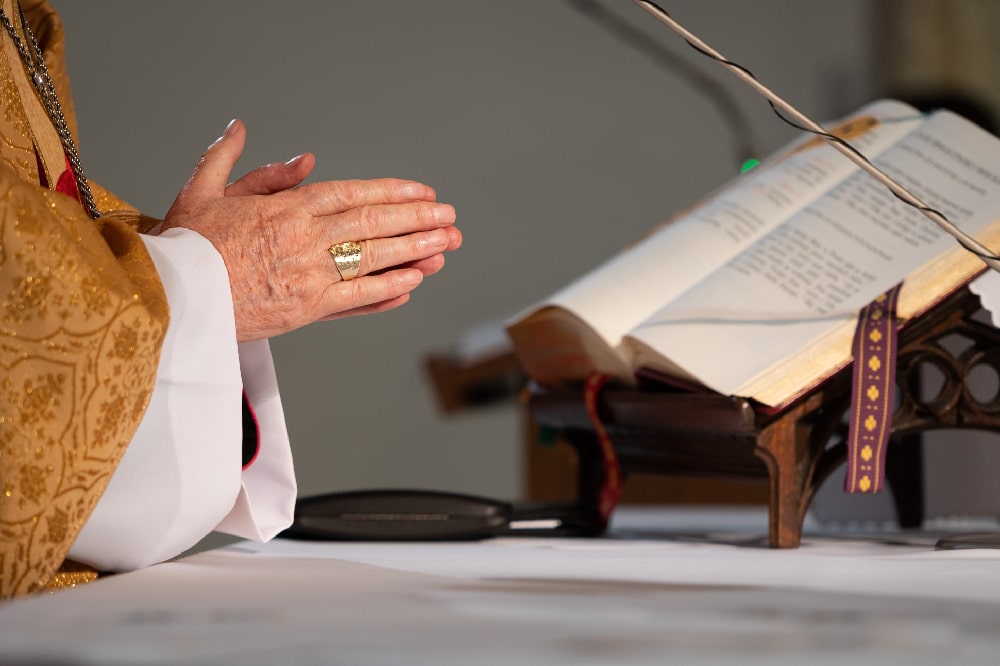
As with every other aspect of religion, the jewellery worn by high-ranking prelates such as Bishops, Archbishops, and Cardinals is not merely ornamental or decorative, but carries a strong symbolic value. In particular, the episcopal ring, worn by Bishops during the most solemn celebrations, symbolises their total dedication to the Church, and their choice of obedience and service.
However, the symbolic value of the episcopal ring, like all sacred rings, is not limited to the meaning attributed to it over the centuries. The ring, by its very shape, has always carried a profound and universal significance, which the Catholic Church has made its own. The earliest rings date back to the Bronze Age and, even in ancient civilisations like the Egyptians, they were used as distinguishing marks of eminent figures or as seals for important documents. This derives from the circular shape itself—a symbol of perfection, infinity, and eternity—which for the Church also translates into sanctity. Just think of the halos that crown the heads of the Madonna, Christ, and the Saints, which are almost always round, or the custom of exchanging rings in the Sacrament of Marriage, signifying the mutual fulfilment born of the union between two individuals.
Returning to the evolution of the ring as a symbol of both temporal and religious power, in ancient Rome high-ranking priests wore rings first of iron, then of gold, and it was customary for those approaching them to kiss these rings as a sign of deference—a tradition later adopted by kings, emperors, and, with the advent of Christianity, by eminent clergy. Even in the Catacombs, rings decorated with symbolic engravings have been found, showing that the first Christians immediately adopted this symbol.
Let us not forget the Ring of the Fisherman, one of the oldest traditions linked to papal election and one of the most symbolically rich objects in religion and Catholicism.
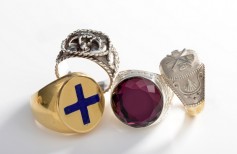
The precious stones adorning the rings worn by Bishops (amethyst), Archbishops (yellow topaz), and Cardinals (sapphire or ruby) not only denote ecclesiastical hierarchy but also carry specific symbolic meanings.
The choice of the amethyst as the gemstone for the Bishop’s ring is no coincidence. This stone is already mentioned in the Bible among the ceremonial vestments for Aaron that the Lord instructed Moses to prepare: “10 And they set in it four rows of stones: the first row was a sardius, a topaz, and a carbuncle: 11 And the second row, an emerald, a sapphire, and a diamond: 12 And the third row, a jacinth, an agate, and an amethyst: 13 And the fourth row, a beryl, an onyx, and a jasper: they were enclosed in settings of gold. 14 And the stones were according to the names of the children of Israel, twelve, according to their names; like the engravings of a signet, every one with his name” (Exodus 28:10–14).
Bishop’s ring of gold plated 925 silver with amethyst of 2 cm of diameter, handmade in Italy by a company specialised in silversmithing.
The symbolic value attributed to this beautiful violet stone—and therefore to the episcopal ring set with an amethyst—has even older origins, rooted in ancient Greek myths. According to legend, Amethyst was a nymph transformed into a splendid crystal by the goddess Artemis to protect her from Dionysus, the god of intoxication. Regretful for having pursued her and caused her transformation, Dionysus poured wine over the crystal, turning its clear colour into the distinctive shade we know today. Perhaps because of this mythical link to Dionysus, amethyst has long been believed to ward off drunkenness—the Greek word améthystos means “not drunk.” In ancient Rome, amethyst cups were used during aristocratic banquets.
According to crystal therapy, amethyst is a stone that brings balance and self-control, fosters self-esteem, encourages pleasant dreams, and wards off nightmares.
The choice of this stone for the Bishop’s ring is connected to its colour: violet, a sacred colour that evokes penance, waiting, and mourning, but also the mystical union between Jesus and his Church. It is especially used during Advent and Lent.
The early Christians quickly associated amethyst with Christ, recognising in the crystal the purity of the spirit and in its violet and reddish hues the signs and wounds of the Passion. Over time, amethyst has become a symbol of the humble—those who, like Christ, choose to sacrifice themselves for others while continuing to pray for those who persecute them. It also represents trust, piety, humility, sincerity, and spiritual wisdom—making it the chosen stone for Bishops, shepherds of souls and guardians of the Church.
The Bishop’s Ring
It was during the Fourth Council of Toledo in 633 AD that it was established that upon ordination, a bishop should receive, in addition to the stole (or orarium) and the pastoral staff, an anulum—a ring—emblem of pastoral dignity, to be worn on the right ring finger. Saint Charles Borromeo, at the end of the 16th century, decreed that the episcopal ring must be made of gold, although over the centuries some bishops have chosen more humble materials, set with an amethyst.
Today, Bishops receive the Gospel, symbol of their duty to spread the Word; the mitre, symbolising holiness; the crosier, representing their mission as shepherds of souls; and the ring with amethyst, symbolising fidelity to the Church.
Topaz—the magnificent golden-hued stone that adorns the Archbishop’s ring—is also mentioned in the Bible among the sacred gems to be set in the breastplate of the High Priests, associated with the twelve tribes of Israel, the twelve angels who guard the Ark of the Covenant, and those who preside over the gates of Heaven.
For the Egyptians, topaz was the stone of Ra, the Sun God. Its name in ancient Sanskrit means “fire.” Its brown and golden colour recalls the sun, the earth, fertility, and life. According to the Greeks, it bestowed physical and mental strength.
Cardinals have their own ring, documented as early as the 12th century, which is bestowed by the Pope during a secret consistory, symbolising their dignity and alliance with the Church. The Cardinal’s ring is set with either a sapphire or a ruby and differs from other pastoral rings in that it is engraved—either on the ring itself or on the reverse of the stone—with the insignia of the Pope who granted it. It is also slightly larger, as it must be worn over pontifical gloves.
Bishop ring with natural carnelian, gold plated 925 silver.
Sapphire has always been associated with the divine in every culture. Solomon’s seal was in fact made of sapphire; the ancient Persians regarded it as the sacred stone par excellence and believed it was sapphire that gave the sky its blue colour. One ancient tradition holds that the tablets of the Ten Commandments were made of sapphire.
In ancient Egypt, it was the stone of truth and justice; for Charlemagne, who always wore a sapphire amulet, it was an expression of love for God. It was Pope Innocent III in the 13th century who decreed that Cardinals should wear the sapphire ring on their right hand.
Considered the king of precious stones, ruby was once the wedding ring stone par excellence. It represents enthusiasm and zest for life, love, freedom, as well as strength, health, and passion. It protects from physical and spiritual harm and brings courage and invincibility.
Situated within two penitential and anticipatory periods of the liturgical year, Gaudete Sunday and Laetare Sunday celebrate the joy of...
4 March 2026
What’s the Future of Religion?
What’s the Future of Religion?
A Beginner’s Guide to Christianity
A Beginner’s Guide to Christianity
Mind-Blowing Statistics About Christianity You Need to Know
Mind-Blowing Statistics About Christianity You Need to Know
7144
Enter the Holyart world: $20 discount voucher valid on over 60,000 items
Come and discover Holyart, the largest e-commerce of religious articles in Europe and immediately receive a $20 voucher to use with your first purchase.
Check your mailbox: you will receive your discount within 5 minutes