In an age where the world seems to be rushing ever faster towards an uncertain future, ancient prophecies resurface from the past, almost as if whispering to us that human history follows predetermined designs, paths already traced centuries ago by enlightened minds or, perhaps, by divine intervention. Among these prophecies, one of the most fascinating and debated is certainly the one attributed to Saint Malachy, a 12th-century Irish monk who is said to have predicted the succession of all the popes until the end of time. A mysterious document which, through enigmatic Latin phrases, appears to have traced with unsettling precision the destiny of the papal throne through the centuries.
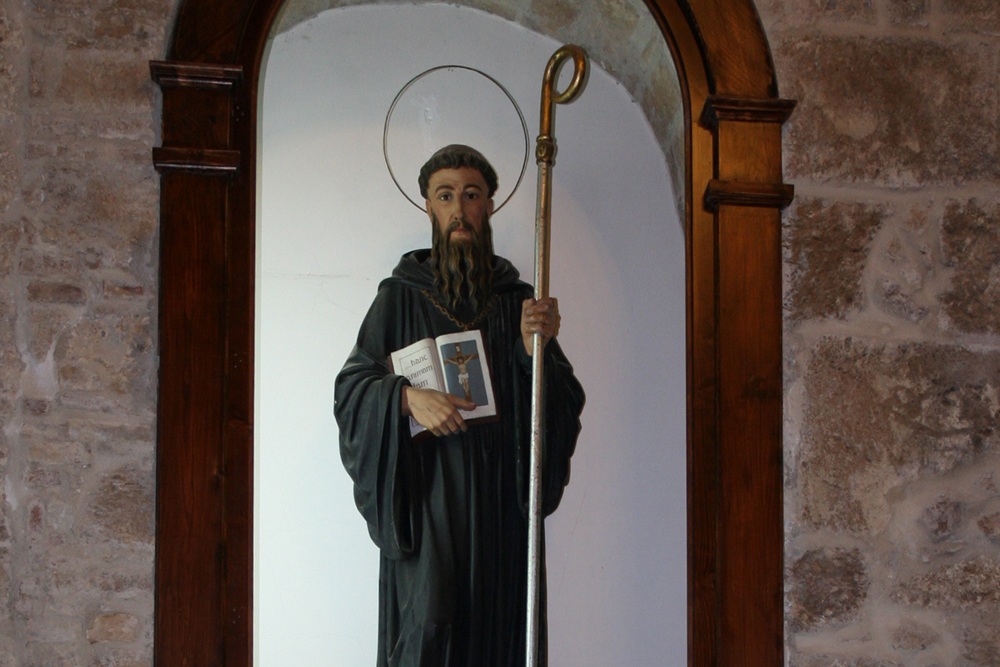
Let us begin with the established facts. In the heart of medieval Ireland, amid misty woods and stone abbeys, lived a man capable of looking beyond time. His name was Malachy of Armagh, now venerated as a saint. Born in 1094, Malachy was a bishop, reformer, and mystic. His faith burned like a silent fire among the ruins of a rebuilding Europe. Legend depicts him as a man with profound visions, marked by an aura of prophecy.
During a pilgrimage to Rome around 1139, Malachy is said to have been struck by a shocking vision: the sequence of the popes who would succeed one another until the end of time. Upon his return to Ireland, it is told that he put those flashes of the future into writing, leaving a cryptic manuscript entrusted to the silent shadow of a secret library. The document, lost for centuries, was only published in 1595, attributed to the Benedictine abbot Arnold de Wyon.
But who can truly say where truth ends and legend begins? Saint Malachy and his gaze into the future still live on, his prophecy—whether true or alleged—echoing in the whispers of church aisles, the murmurs of pilgrims, the shivers of those seeking hope or fearing for the future of us all.
Who Was Saint Malachy
Malachy of Armagh was born and raised amid the misty moors and abbeys filled with silence and prayer in 12th-century Ireland. He was a monk, later an archbishop, reformer, and miracle worker. His spirit burned like a torch in the northern lands, fuelled by unwavering faith and a deep intimacy with mystery. He was a friend and confidant of Saint Bernard of Clairvaux, the beacon of the Cistercian order and spiritual father to whole generations of men of faith. It was Bernard who penned an intense and heartfelt biography of Malachy, but crucially for us here, without any mention of prophetic visions. Nothing in the account of the Cistercian monk hints at the existence of what, if authentic, would be among the most staggering prophecies in Christianity.
Saint Bernard of Clairvaux, lace-embellished holy card, 4×3 in. The holy card of Saint Bernard of Clairvaux is crafted from fine cotton fibre paper…
Yet it is told that it was precisely during a pilgrimage to Rome around 1139 that Malachy was seized by a mystical ecstasy, in which he received the vision of the entire succession of future popes until the end of time. A dizzying revelation, reportedly noted in a secret manuscript then kept in the vaults of the Vatican and resurfacing centuries later.
Whether history or legend, this vision would have travelled through time like a prophetic whisper, delivering to us the list of 112 popes destined to steer the Church before the Last Judgment.
Malachy’s Prophecy
In 1595, in a volume titled Lignum Vitae, the Benedictine monk Arnold Wion published a mysterious document: a list of 112 Latin mottos, each referring to a pope from Celestine II (1143) to a future pontiff called “Petrus Romanus,” the one who would lead the Church during its ultimate persecution before the Last Judgment.
The work, titled Prophetia Sancti Malachiae Archiepiscopi, de Summis Pontificibus, seemed to enclose the fate of the Church in a poetic and indecipherable sequence: brief phrases such as “De gloria olivae,” “Pastor angelicus,” “Lilium et rosa,” obscure evocations, rich in symbolism, sometimes unsettling in their apparent correspondence to real events.
Yet, no one had ever heard of this prophecy before the 16th century. Not a manuscript, not a citation, not a fragment. No trace in the Middle Ages or the centuries immediately following Malachy’s death. A deafening silence that raises profound questions.
Many historians today believe it to be a forgery created deliberately, perhaps to influence the conclave of 1590. One of the mottos, “Ex antiquitate urbis,” seems to directly allude to Cardinal Girolamo Simoncelli, originally from Orvieto (Urbs Vetus), a candidate for the papal throne. A propagandistic device, then, disguised as divine inspiration.
Other clues fuel suspicion. Some scholars attribute the forgery to the physician and writer Alfonso Ceccarelli, a famous forger of the time, though the chronology does not perfectly match. Certainly, the prophecy appeared in a period of great political instability, when predictions and oracles circulated frequently, used to justify, influence, or legitimise temporal and spiritual powers.
Here are the mottos from the prophecy attributed to the most recent popes:
De medietate Lunae: John Paul I (Albino Luciani, 1978). The “Pope of the half moon,” so called because of the brevity of his pontificate, lasting only 33 days, like a half moon in the sky.
De labore Solis: John Paul II (Karol Wojtyła, 1978–2005). “From the labour of the sun”: born and died during two solar eclipses, his pontificate was marked by an intense light cutting through the shadows of the world.
Gloria olivae: Benedict XVI(Joseph Ratzinger, 2005–2013). “The glory of the olive”: a nod to the Benedictine order, of which he was a member, and a symbol of peace in turbulent times.
In persecutione extrema S.R.E. sedebit: Francis (Jorge Mario Bergoglio, 2013–2025). “He will sit during the final persecution of the Holy Roman Church.” This is the motto attributed to Pope Francis, the 111th on the list.
A son of the other Rome, that of emigration, a shepherd come “from the ends of the earth,” Francis did not bear the name Peter, but perhaps embodied its spirit: simplicity, the rock, the cross. Whether he was the “Petrus Romanus” or merely the last custodian before silence, no one can say.
Pope Francis: category dedicated to Pope Jorge Mario Bergoglio..
Prophecy About the Last Pope
There is no concrete proof of the authenticity of this prophecy. It only resurfaces in times of crisis, after the death of a pope, or in the days following Benedict XVI’s resignation, testifying to the symbolic power it continues to wield far beyond its documentary value. Yet, centuries after his death, the name Malachy remains synonymous with omen, end, revelation.
What has left the deepest mark on the collective imagination is the last entry on the list.
Not a motto, but a true apocalyptic warning:
“In persecutione extrema Sanctae Romanae Ecclesiae sedebit Petrus Romanus, qui pascet oves in multis tribulationibus: quibus transactis, civitas septicollis diruetur, et Iudex tremendus iudicabit populum suum. Finis.”
“In the time of the greatest persecution of the Holy Roman Church, Peter the Roman will sit, who will shepherd the flock through many tribulations: and when these are ended, the city of the seven hills will be destroyed, and the terrible Judge will judge his people. The End.”
A solemn closure. Definitive. Without appeal.
This Petrus Romanus, the pope of the end, has sparked bold hypotheses, millenarian fears, and theological debates for centuries. His enigmatic figure has crossed the ages like a prophetic shadow, feeding speculation, fears, and hopes. In that arcane phrase, Petrus Romanus, many have sought clues, omens, reflections of the present. Some have even tried to identify him with modern pontiffs, suggesting a link to Pope Francis, because of the Italian roots of his family and the name of his great-grandfather: Giovanni di Pietro. Was Francis the penultimate pontiff before the end?
Read more:
20 curiosities about Pope Francis
Information about Pope Francis, curiosities and his pontificate’s special moments. A Pope who made himself…
Today, Saint Malachy’s prophecy appears more as a cultural phenomenon than a spiritual one. A fascinating enigma that has traversed the centuries more for its evocative power than for any genuine divine inspiration.
Its authenticity is highly doubtful, stifled by the silence of sources, its late emergence, and the manipulative context in which it was published. Yet, it has left an indelible mark. In a world often hungry for signs and omens, for meaning and catharsis, Malachy’s words, true or false, continue to ring as a warning bell.
Perhaps their power lies not in historical accuracy, but in the unease they evoke, the sense of waiting, the thrill of “it could be true.”
And so Malachy remains for us an eternal symbol of the tension between faith and the end, between the need to believe and the fear of nothingness. Even if his prophecy were but a shadow among the pages of time, that is precisely where its mystery lies:
in the echo of words that cross the centuries without seeking confirmation.
The healing of the paralytic in Capernaum is one of the many miracles of Jesus, but it contains a series...
16 March 2026
What’s the Future of Religion?
What’s the Future of Religion?
A Beginner’s Guide to Christianity
A Beginner’s Guide to Christianity
Mind-Blowing Statistics About Christianity You Need to Know
Mind-Blowing Statistics About Christianity You Need to Know
7305
Enter the Holyart world: $20 discount voucher valid on over 60,000 items
Come and discover Holyart, the largest e-commerce of religious articles in Europe and immediately receive a $20 voucher to use with your first purchase.
Check your mailbox: you will receive your discount within 5 minutes