How Pope Francis transformed the Church during his pontificate
24 April 2025
Reading Time: 10minutes
What did Pope Francis do that was important? His pontificate was a revolution of mercy that transformed the Church, taking her from the peripheries to the heart of the world with humility, courage and openness to dialogue.
It is not easy to summarise what made Pope Francis significant. There was something extraordinarily human about Pope Francis, Jorge Mario Bergoglio, the Pope who came “from the end of the world” as he called himself on the day of his election on 13 March 2013. This made him the spiritual leader of over a billion Catholics and a father, brother, and friend to anyone who crossed his path. His pontificate represented a gentle revolution that profoundly transformed the face of the Church, making it more accessible to the least and more responsive to the challenges of our time. Pope Francis has transformed the Catholic Church into a refuge of mercy, justice and hope. Now that he is no longer among us, the whole world stops to remember the man who forever changed the face of the Church.
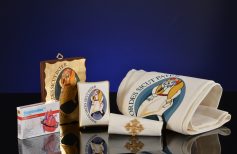
Pope Francis’ Good Shepherd’s Cross, rosary beads, pictures, key chains and much more.
In recent years, he has faced immense challenges: the pandemic, the escalation of global conflicts, and the climate crisis. His voice was raised with particular force against the violence in the Holy Land, denouncing the spiral of hatred and revenge that has bloodied Gaza and Israel, and tirelessly invoking dialogue as the only way to peace.
His humility, genuine smile, and ability to speak to people’s hearts with profound but straightforward words made Francis a beloved Pope far beyond the borders of the Catholic Church. He taught that the true revolution is that of tenderness, that true strength lies in service, and that true greatness lies in humility.
His pontificate has left us a Church that is more open, more synodal, more attentive to the signs of the times. A Church that is not afraid to get its hands dirty to stand beside the least, that is not afraid to face its own contradictions to be more faithful to the Gospel. Francis taught us that faith is not a refuge for frightened people, but a courageous journey of hope and love.
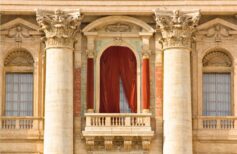
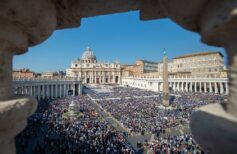
Francis was the Pope of the peripheries, not only geographical but also existential. His voice, always firm yet compassionate, has resounded in the world’s most forgotten places. Who will ever forget his solitary figure, in a deserted and rainy St. Peter’s Square, during the pandemic? That image has become the symbol of a Church that does not abandon its children in the moment of pain, but walks with them through the storms of life. Pope Francis was a man of the people. From the moment he first stepped out of St. Peter’s Lodge asking the faithful to pray with him, it was clear that his pontificate would be different. “Now let us begin this journey: Bishop and people, Bishop and people” were his words, addressed to the more than 180 thousand people who crowded St. Peter’s Square. Immediately afterwards, he rejected the pomp of papal power, preferring to live in the simple Casa Santa Marta rather than in the sumptuous apostolic apartments. This symbolic gesture was only the beginning of a journey that would bring the Church closer to the poor, the marginalised and those who had lost hope.
Pope Francis statue in resin 14 cm.Hand-painted resin Catholic statue portraying Pope Francis with his hand raised, on a round base.
Reforms and Transparency: Francis’ New Church
His reform of the Roman Curia, culminating in the Apostolic Constitution “Praedicate Evangelium” (promulgated on 19 March 2022), was not only an organisational change but also a real revolution. Francis wanted a Church that was not a “customs house”, but a “field hospital”, as he liked to repeat, where to heal the wounds of suffering humanity. Francis has been able to transform the Vatican administration, making it more streamlined and oriented to the evangelising mission. But it is not just about bureaucracy: this reform was an act of justice and transparency, an attempt to restore credibility to a Church often stained by financial scandals and abuses of power.
The beating heart of this reform is evangelisation. Francis wanted the Curia to no longer be seen as a Vatican “ivory tower”, but as a living instrument to bring the Gospel to the contemporary world. A strong sign of this change is the creation of the new Dicastery for Evangelisation, placed directly under the guidance of the Pope, a choice that underlines how the spread of the evangelical message is the Church’s absolute priority.
The reform also introduces a new style of governance based on synodality, that is, on walking together. For the first time in history, lay people can assume leadership roles in Vatican dicasteries. This change reflects the vision of a Church that values all its members, not just the clergy.
The Vatican financial reform he promulgated also represented a historic turning point for the Holy See’s transparency. At the heart of this transformation was the reform of the IOR, the Vatican Bank, which had been at the centre of scandals and controversies for decades.
Francis introduced a rigorous system of controls and procedures, aligning Vatican financial practices with international standards. It created new oversight bodies, such as the Secretariat for the Economy, and implemented strict procurement and fund management rules. A crucial aspect was the adoption of anti-money laundering regulations and collaboration with international bodies to ensure the traceability of transactions. This technical and cultural reform marked the transition from opaque and self-referential management to a culture of responsibility and transparency, where every euro spent must be justified and documented.
The fight against abuse
Perhaps one of the most difficult chapters of Pope Francis’ pontificate was the fight against sexual abuse in the clergy. The Pope did not limit himself to condemning, but acted with determination, introducing strict norms and calling all the clergy to a painful but necessary examination of conscience. His authenticity in acknowledging past mistakes has paved the way for an ongoing healing process. Francis instituted rigorous norms and issued the Vos estis lux mundi (in English “You are the light of the world”), an Apostolic Letter in the form of a Motu Proprio written on 7 May 2019, which represents a decisive turning point in the fight against abuse. Before this law, there was some ambiguity in the procedures to be followed, especially when the facts involved figures of high ecclesiastical rank, such as bishops. In addition, victims often encountered significant obstacles in reporting abuse. Vos estis lux mundi establishes clear and mandatory procedures for reporting abuses. Each diocese must have easily accessible reporting systems, and all members of the clergy and religious are required to report abuses of which they become aware. Secondly, the document extends liability not only to sexual abuse of minors, but also to those of vulnerable adults and the abuse of authority to obtain sexual acts. It also includes protection for whistleblowers from possible retaliation.
Custodian of the common home and prophet of universal brotherhood
His encyclicals charted the course for a Church of the third millennium. With Laudato Si ‘ (2015), Pope Francis spoke to Catholics and the whole world. His call to care for the planet as a “common home” resounded loud and clear in an era marked by the climate crisis. It was not just a spiritual message, but a political and social wake-up call that prompted millions to reflect on their role in protecting the environment.
Pope Francis devotional trisagion in coconut imitation wood. Trisagion with 6 mm grains made in coconut imitation wood, with metal setting.
Amoris Laetitia (The Joy of Love) represents one of the most significant and discussed documents of Francis’ pontificate. Published on 8 April 2016, this apostolic exhortation marked a turning point in the way the Church deals with the complex family realities of the contemporary world. The document stems from the reflections that emerged during two Synods on the family (2014 and 2015), where bishops from all over the world discussed the challenges that families face today. At the heart of Amoris Laetitia is a vision of the family as a dynamic and evolving reality. The Pope recognises that family situations are not always ideal and that the Church must be able to accompany people on their concrete paths of life. Particularly innovative is the approach towards the so-called “irregular situations”, such as divorced and remarried couples, within which elements of grace and authentic love can be present. The Pope invites the Church to look beyond the categories of “regular” and “irregular” to recognise the good present in every family situation.
With the encyclical Fratelli Tutti (2020), Pope Francis offered a prophetic vision of universal fraternity in a world torn apart by conflicts and divisions. The document was signed in Assisi, on the tomb of St. Francis, a highly symbolic place, because the teachings of the Saint of Assisi on universal fraternity inspire the encyclical. The world was going through the COVID-19 pandemic, a period that highlighted global interconnections and deep social inequalities like never before. Pope Francis elaborated much of the document right during the lockdown, turning that moment of global isolation into an opportunity to reflect on the deep meaning of human fraternity. The title Fratelli Tutti takes up an expression of Saint Francis of Assisi, who used it to address all brothers and sisters, proposing a form of life that refers to the dictates of the Gospel. The encyclical fits into a particular historical moment, also in other aspects: the growing international tensions, the emergence of nationalisms, the refugee crisis, and the growing economic inequalities have made its message on universal brotherhood and social friendship particularly relevant and urgent.
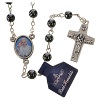
This rosary has grains in perfumed PVC measuring 7mm, with Good Shepherd cross and image of Pope Francis on the medal.
Francis dreamed of a world without walls, where everyone could live as brothers. His cry of pain for wars, from Syria to Ukraine, from the Holy Land to Sudan, has always united denunciation with hope, firmness with mercy. It has also been able to revolutionise interreligious dialogue. Abu Dhabi’s historic meeting with the Grand Imam of Al-Azhar and the trip to Iraq showed that dialogue is not a utopia, but a necessity for our time.
The Document on Human Fraternity for World Peace and Common Coexistence, signed on 4 February 2019 by Pope Francis and the Grand Imam of Al-Azhar, Ahmad Al-Tayyib, is a prophetic and revolutionary statement that outlines a vision of hope for humanity. It prophesies a world founded on dialogue, peace, and justice, inviting everyone —believers and non-believers —to collaborate in building a society based on human dignity, equality, and universal brotherhood. The document denounces the divisions, wars and injustices that afflict the world, pointing to brotherhood as the only antidote to hatred and extremism, and prophesies a future in which the culture of dialogue becomes the path to prevent conflict, mutual respect replaces discrimination and collaboration between peoples becomes the method to face global challenges. In particular, it strongly condemns all forms of terrorism and violence perpetrated in the name of religion, affirming that God does not need to be defended through innocent blood. The document says this: “There is no alternative: either we will build the future together or there will be no future. Religions, in particular, cannot renounce the urgent task of building bridges between peoples and cultures. The time has come for religions to engage more actively, with courage and audacity, without pretence, to help the human family develop the capacity for reconciliation, a vision of hope, and the concrete itineraries of peace.”
Read more:
The 5-Finger Prayer by Pope Francis
The 5-Finger Prayer is an effective method suggested by Pope Francis to ensure that no one is forgotten in our prayers.
A Pope on a Journey: Francis, a Pilgrim of Peace
For Pope Francis, trips were not simple diplomatic visits, but proper pilgrimages of peace in places wounded by history. Each visit left a tangible legacy: in Iraq, it rekindled the hope of persecuted Christian communities, in Myanmar and Bangladesh, it gave voice to the voiceless, and between Cuba and the United States, it helped to dissolve decades of hostility. Its ability to go to the “peripheries” of the world, not only geographical, but also existential, has redefined the role of the papacy in the 21st century.
The trip to Iraq in March 2021 represented an unprecedented historical moment: for the first time, a Pontiff visited the land of Abraham, the cradle of ancient civilisations and the scene of modern conflicts. In a country devastated by wars and sectarian violence, Francis brought a message of reconciliation and brotherhood. The meeting with Grand Ayatollah Al-Sistani in Najaf and interfaith prayer in the ruins of Ur demonstrated how dialogue between different faiths is not only possible but necessary to build peace.
In 2017, his trip to Myanmar and Bangladesh brought global attention to the tragedy of the Rohingya, a persecuted Muslim minority. In Myanmar, while maintaining a delicate diplomacy, Francis defended the rights of minorities. In Bangladesh, the moving encounter with Rohingya refugees showed the world the human face of this crisis, with the Pope asking forgiveness for global indifference to their suffering.
The visit to Cuba and the United States in 2015 highlighted the Church’s role as a bridge-builder between divided peoples. Francis played a key role in thawing relations between the two countries, facilitating behind-the-scenes diplomatic dialogue. In Cuba, he met Fidel Castro, while in the United States, he became the first Pope to speak to the US Congress, addressing crucial issues such as immigration and climate change.
A shepherd close to the weak
Pope Francis’ heart beats for the poor and migrants. In 2013, when he was just installed on the Papal Throne, he visited Lampedusa to denounce the tragedies of forced migration and transformed the Church into a tireless voice against the policies of closure and indifference. His commitment to migrants will remain one of the hallmarks of his pontificate. His voice has risen tirelessly against what he has called “the globalisation of indifference.”
Pope Francis created the Dicastery for Promoting Integral Human Development to coordinate the Church’s social action, making the Gospel message of charity tangible. The Dicastery is a body of the Roman Curia established on 17 August 2016 with the Apostolic Letter Humanam Progressionem, dedicated to promoting integral human development in light of the Gospel and the Church’s social doctrine. It officially began its activities on 1 January 2017, incorporating the competences of four pre-existing Pontifical Councils: Justice and Peace, Cor Unum, Pastoral Care for Migrants and Itinerant People, and Pastoral Care for Health Workers.
The Dicastery deals with fundamental issues such as justice, peace and human rights; health and dignity of the person; care for creation as a “common home”; migration, humanitarian emergencies and support for the most vulnerable, such as prisoners, the unemployed, victims of armed conflicts, natural disasters or human trafficking.
The healing of the paralytic in Capernaum is one of the many miracles of Jesus, but it contains a series...
16 March 2026
What’s the Future of Religion?
What’s the Future of Religion?
A Beginner’s Guide to Christianity
A Beginner’s Guide to Christianity
Mind-Blowing Statistics About Christianity You Need to Know
Mind-Blowing Statistics About Christianity You Need to Know
7037
Enter the Holyart world: $20 discount voucher valid on over 60,000 items
Come and discover Holyart, the largest e-commerce of religious articles in Europe and immediately receive a $20 voucher to use with your first purchase.
Check your mailbox: you will receive your discount within 5 minutes